Friday, 16 August 2013

One year on


I've done it! Almost a year on and with my implant still in place – I have to say, I LOVE it!

I had my final check up this week, just to check things over and see how I was getting on. I also had to do some speaking and listening tests.

For my speaking tests, I was filmed and presented with several different scenarios. For example, I was given six pictures and had to talk about what was happening in each one. Another was reading out a conversation between two people and so on. They use these trials to determine whether my speech has improved as a result of the change in my hearing.

We then moved on to some singing, "pitching" sounds starting from low to as high as I could get, and then from high to low. This was quite funny to do in front of the camera. As you might imagine, it's difficult to pitch a note if you can't hear yourself so I was being assessed to see whether I've improved since having the implant. I mentioned to them that I can hear my voice more now and feel I have more control over it. I know I sound a bit quieter too when I talk.

I was asked if I had done singing lessons. I answered no, but I'm thinking, shall I give it a go?

For my listening tests, I had to face a speaker, listen to several sentences and repeat them back. The sentences were random like "the letter landed on the mat", "the children went to the bus stop". When I did this test before having the implant, I heard nothing. With my implant, I got about half right. I was really pleased. I still have time to improve.

I've been encouraged to use the telephone, which I do use, although rarely, but more than I have done over the years. However, I'm happy not to use the telephone unless I'm making the effort or have to. However, the option is there and I know what to say if I can't make sense of what is being said. I ask the caller to repeat but in a different way so that my brain has time to try and figure out what they're trying to say.


We went away on holiday to Ibiza last week and had a lovely time. Addenbrookes were great. They sent me two letters for the security people at the airports, explaining that I have a cochlear implant and can't pass through metal detectors; one in English, another in Spanish.

They also provided me with a replacement processor (they bit behind my ear) via MED-EL, the implant manufacturer, just in case anything went wrong with my one.

At the airport security on departing the UK, I had almost forgotten what I was supposed to do as I was more concerned about a poor mother in front of me. She had several bottles of suncream in her hand luggage and wasn't allowed to take through onto the plane. The security guard grabbed them and dumped them in a bin. I suddenly realised that I needed to let them know I had an implant and wondered if she was going to make things difficult for me?

It all went smoothly, and there were no problems when coming back home from Ibiza. All very straight forward.


On the aeroplane I took my implant out, only because it was very noisy. My ears did pop a few times so I was glad I had packed some chewing gum and sweets.

When I say I LOVE my implant, it's not because it's one big miracle and that I'm "hearing" again. It's because it feels lighter, clearer, more hassle-free (from my old hearing aids) and it's also given me back some confidence. I also love the fact that I no longer have to worry that my hearing will degenerate as I get older – something that I had been worried about over the years. The level of hearing I have now will always stay the same, perhaps even improve slightly. It's up to me to carry on improving and I will persevere.

Don't get me wrong though, I do still have some difficult days. Especially when I'm surrounded by so many people talking at once and there is a lot of noise going on in the background. This could be children, or traffic or whatever there is. Sounds echo in the spaces like the kitchen for example and trying to listen to people talking is still really hard. There's only so much I can take when being with a lot of people and I've now learnt that when I'm tired, it means my brain has had enough and I need some quiet. It's only because so much sound is going into my head and it gets a bit too much. As long as people are aware, it makes it easier for me.

I've stayed in touch with a lot of my friends from my school days and gained new friends too, particularly those who are either considering an implant, and those who have already had it done. I've also lost some friends because they have their own views and dislike the fact that I had the implant done. Do I mind? Not really but I shall say no more about it.

When people ask me about the cochlear implant, I make sure that I'm not biased and I answer their questions as best as I can. I talk about my experiences and mention my blog to them. I do say everyone is different and that it doesn't work for everyone in the same way. I like to feel I'm there for them, in whatever decision they decide to take.

So, the first year is over. It's been a huge challenge. I wonder what my next one should be...

Saturday, 6 April 2013

Eight months on, how am I doing?

The answer? Probably that I've spent far less time focusing on my August 2012-fitted Cochlear Implant than I was hoping.  The last eight months have been a hectic combination of moving home, decorating, gardening and navigating endless, gritless, ice and snow-laden roads in our new rural location.

I admit to initially feeling rather guilty that I wasn't focusing entirely on my implant.

Only because I was given exercises to do, but just hadn't the time to do them. These exercises involved listening to audio books while trying to follow the words in the book, practising using the telephone, lip-reading TV presenters without using subtitles, listening to the difference between sounds like "castle" and "parcel" with eyes shut and so on.

But incredibly, and seemingly just through using my implant during the challenges of everyday life, I've experienced a huge improvement. I guess my brain should really take the credit for this, rather than me personally.

Perhaps most surprising is the fact that I no longer wear a hearing aid. I wore my hearing aid on the ear that wasn't operated on for a good four weeks before and then for a few weeks after the switch on. I wore it mainly for school runs to help me cope with conversations in the playground.

One day, I thought I'd go without it, and have not worn it since. It was extremely difficult and enough to make me cry, thinking "this is never going to work". I kept thinking "I can't hear anything". Everything was just noise. I could hear everything but understand nothing. I had numerous headaches and frustrations, but I was determined to stick with it - if only because it would be rather difficult to remove the surgically implanted device inside my head. I told myself I must not fall back and put my hearing aid back in. I must let my brain get used to the new experience.

We went to Center Parcs last week. Conscientiousness and organised as ever, I had told myself that if my processor breaks (the bit I wear outside my ear), I could rely on one of my hearing aids as a back-up. The last time I used my hearing aid was in September 2012, but I thought I'd better test it.  It was a job trying to squeeze the ear mould into my ear. I switched it on. I couldn't hear anything. I tried a different hearing aid (I've collected a few over three decades) and the same thing happened. I listened harder and realised that all I could hear were beeps and squarks - not unlike what I first heard when I had my implant first switched on.  I've worn hearing aids for thirty years but have now lost my ability to hear with them - without re-learning at least.

I won't talk at length, but in essence, having the Cochlear Implant has been an amazing experience. I'm not now "hearing" as some people may wonder, but I do seem to have got back the limited hearing that I used to have as a child, as well as gaining new sounds, resolution and interpretation that I hadn't even considered or knew existed.

People are keen to know what sounds I can hear now. They also ask why I can hear certain sounds only just now, rather than as soon as the implant was switched on. As I've found out, it takes time for the brain to "learn" these new sounds. I imagine it's a bit like muscle memory and learning to walk again after having an accident. It requires a lot of determination and patience.

I can definitely hear my husband's voice and my boys better than ever before. Speech sounds a lot sharper and clearer. It's far from "normal" but it is better.  It has improved considerably over the months, and was something that had been bothering me a lot from the beginning.

I did question myself as to whether I'm still "Deaf" for the first few months after the operation. It's strange and difficult to explain, but I'm sure a lot of people will understand what I'm trying to say. I still tell people I'm "Deaf" because I am, even though I can hear clocks ticking and taps dripping.  I can understand how some people feel trapped in a no-man's land between the Hearing and Deaf communities.

I still love signing and relish the opportunity to do so. It's just that my hearing aids weren't helping me as much as they once did. I personally felt I needed more hearing, and the confidence that comes with it, to help me cope bring up my two young boys. I didn't want to hold them back in any way.

I must say that my friends and family have been very encouraging and supportive, and this has helped a lot. Once or twice, I've pulled out my processor, and cried out "it's not working!" My close friends and family have spurred me on and for that I'm really grateful.

I'm due to have my eight month check-up in the middle of April. It has been four months since I was last at Addenbrookes in Cambridge. I'm wondering how my hearing test and audiogram will compare to my last, and my first. I'll let you know.

Thursday, 20 September 2012

New sounds for the first time

It was a challenge to take the boys back to school at the start of term. The noise in the playground. Voices everywhere. Children chasing around. Scooters and bikes rattling. I guessed it would be like this, so wore my old hearing aid on my other ear for support.

It was lovely to see old friends again, some of whom I hadn't seen for the weeks over the summer holiday. I should have prepared some words on how I was getting on and what I was experiencing, but it was and continues to be really difficult to explain.

During noisy times, the best description of the sound I'm hearing is like a jangling set of keys on a key ring. But it's not always like this. The biggest change I've noticed is being able to pick up quieter sounds. Seriously quieter sounds.  And higher pitched sounds too.

Here are some examples of what I've heard recently for the first time in my life:

  • Birds twittering in the garden
  • Leaves rustling in the trees, and my t-shirt flapping during a run
  • Clock ticking (if I hold it close)
  • Exercise bike in the gym "pinging" at the end of a programme
  • Match flaring after being struck on a match box
  • Candle flickering when blown
  • Smoke alarm (no connection to the two above)
  • Rice Krispies snapping, crackling and popping
  • Rubbing sun cream on skin
  • Spraying perfumes
  • Buttering toast
  • Rubbing hands together
  • Dragging feet on the carpet
  • Breathing (after a run...)
  • Remote control buttons when pressed
  • Difference between S and SH
Quite amazing really, and nothing short of a miracle.  But there's still a long way to go.  After all, I can pick up these new sounds and sometimes distinguish them from other sounds, but I'm not yet always able to remember what they are.  As they warned me, it's going to take a lot of practise. It's a whole new language. I can only imagine this is what it's like for babies, learning the sounds of life for the first time.

Listening to voices remains incredibly hard. Even now, I still cannot tell the difference between Dan and the boys.  It's a real effort to make sure I find the time to sit down in the evenings and practise listening.  Dan will say aloud the months of the year, or days of the week, or family names or numbers.  He reads out news articles as well, or paragraphs from books. I close my eyes and try to work out what he's saying.  The more I do it, the easier it gets.  But it's slow progress. Every word needs to be re-learnt. No doubt I will rely upon lip reading for a while yet.

One small success though - if Dan stands at the other end of the house, in the conservatory, and talks normally, I can hear if he's asking whether I want a cup of tea or mug of coffee. That's quite neat.

My next appointment at Addenbrokes in Cambridge is today. This will be my third programming session, where they will again check and adjust the range and volume of frequencies handled by my implant.  It will be another long day, but certainly interesting to see if it makes any further improvements.  Fingers crossed.

Thursday, 30 August 2012

Switch on - Day 0 (continued)

After a welcome and some introductions with the audiologist, I was handed my shiny new processor (the bit for the outside of my head) in Bordeaux Red and hooked up to her computer.  The switch on took about an hour, and unlike the name suggests, involved more than just a simple flick of a switch.


The implant cable which now sits inside my cochlea has 12 electrodes, which you can see if you look carefully at my x-ray image.  Each of these electrodes is responsible for a different set of sound frequencies, ranging from high to low tones.  The switch on process involves adjusting each electrode in turn, to produce a comfortable range of high and low volumes.

"Ouch!!!!" was my first reaction when I was connected to the computer.  I felt a loud, uncomfortable crash inside my head.  My instant reaction was to rip the processor off my head.  But I resisted, and the sound faded away.  The session continued like this for about 30 minutes, using the computer to throw different tones at different volumes at my implant - the quiet ones were fine, the louder ones brought tears to my eyes.

And then came the moment to listen to the real world... Click.  "Hello Catherine, can you hear me?  I've switched your implant on now.  Testing, testing, 123." I lip read her perfectly.  But what I heard was different.  It wasn't a voice at all.  It was just squawks and beeps and whistles.  It was same for every sound, voice or not.

Walking back to the car, I felt nothing but exhaustion. When we got home, there were so many sounds coming from everywhere and after an hour, I pulled the processor off, and wondered how it was going to work.  I'll be honest, I wasn't expecting it to be quite like this.

While not pleasant and consistently uncomfortable, this reaction is typical, so I'm assured.  My brain will take time to adapt.  But at the moment, it feels like there's an awful lot of adjustment to be made.  

Wednesday, 29 August 2012

Switch on - Day 0

The switch on happened today, and went smoothly.  I'll write a brief summary of the day shortly and upload some photos, but need to gather my thoughts first.  Before then, and over the coming days, I'm going to list all the sounds I'm hearing for the first time.

X-ray of my head

Here's an X-ray of my head, following the operation to insert my implant.  You can see the implant fixed to my skull, and the 12 individual electrodes on the curled wire which sits inside my cochlea.  Click on the image to see a larger one.


Monday, 27 August 2012

The "switch on" is tomorrow

Four weeks after the operation, the day of my "switch on" is almost here. On both Tuesday and Wednesday this week, I'll travel once again to the Emmeline centre at Addenbroke's in Cambridge, to receive a processor for my new implant, and then begin the process of getting it switched on and configured.

I'm desperately excited, but also nervous - in near equal parts. Over the past few months, I've tried to keep my expectations low. But it's difficult not to imagine a life with more hearing than I have now. Will it work for me? Will I be disappointed? Will the sounds I hear just be loud muffles, rather than the quiet ones I hear now? Volume is nothing, clarity is everything. And what about everyone else? My friends and family have been so supportive, I don't want to let them down.

It will be a shock at first. The auditory nerve on the right side of my head, which carries the electrical signals from the implant, won't know what's hit it. From carrying nothing more than a slowly decreasing, drought-laden trickle over the last 34 years, to a gushing deluge in an instant.

Of course, my brain won't recognise most of the signals immediately after the switch on. I've been told I'll hear robotic beeps and whistles to start with - whatever they really sound like. It will take time for my brain to piece together the new sensations with the sounds that are causing them. How quickly this happens, if at all, will depend upon how quickly my brain can adapt. They say it's usually as good as it will ever be after a year.

Whatever happens over the coming days, weeks and months, I know that commitment and dedication from me, and patience and support from friends and family will play a huge role. And from that point of view, I know I'm in the best possible place to make the most of this opportunity.

Monday, 30 July 2012

Thank you everyone

I'd like to express a big thank you to all those who have written messages of encouragement, sent cards, delivered beautiful flowers, given gifts, cooked hot dinners and provided childcare over the past few days.

You've really helped me and are very much appreciated - thank you everyone, not least my wonderfully kind family, the Coopers and Kilkellys (Dan's sister's family).

Saturday, 28 July 2012

Surgery day arrives: Thursday 26 July

Thursday morning followed a slow and restless night spent worrying, apart from the obvious, about not waking in time for an early breakfast before my fasting deadline. It was to be unfounded. I found myself soft-boiling an egg and toasting some soldiers at 5.30am. I needed to be “nil by mouth” from 6.30am, and didn't want to miss getting a good start to the day.


After dropping the boys off with their play buddies for the day, Dan and I made our way to Cambridge, with me in the driving seat. I needed the distraction.

It was a lovely morning for a drive, the sky filled with bright blue and hot sun. We opened the windows and listened to Kiss FM on the radio. Funnily enough, they played several songs I could remember from when my hearing was better. I felt happy, but wondered if these familiar sounds would be the same in the future.

The Spire Cambridge Lea welcomed us more like visitors to a hotel than a hospital. We were shown quickly to my room. A nurse introduced herself, asked some questions and then took my blood pressure and temperature. She suggested I change into the regulation gown and antithrombotic tights straight away, just in case I was first up. I let Dan take a photo, but only if didn’t end up on Facebook. A minute later, “looking good…” was trending under the photo on my profile.

A few minutes later, the anaesthetist entered the room and introduced himself. The surgeon arrived not long after. We were keen to find out what time I was going in. Unfortunately, there was a delay, with my slot now looking to be around late afternoon or early evening. My heart sank.

Dan started to look hungry. To be fair, it must have been a couple of hours for him... I encouraged him to have his lunch. He looked relieved, and said “I guess there’s no point in both of us being hungry?”. I smiled; my tummy groaned.

It was a long afternoon. I had a stash of magazines to read and the TV to watch, but they didn’t really help. There was a garden with a sitting area near my room, so I started to wonder if it was worth getting changed back into my clothes and going out there. No-way was I going out there in my gown. At just that instant, rather ironically some might say, the fire alarm sounded. Seriously?

I rather begrudgingly ended up in the garden. My gown wasn’t tied up properly at the back, and I felt quite exposed from the back. Literally, Dan indicated later. Just call me Bridget Jones. Fortunately, the alarm stopped after 5 minutes, and we went back to my room.

At around 6pm, my turn finally arrived. After one last toilet stop (yes, 8 hours after my last sip of water), I jumped back onto my bed, and was couriered down the corridor to the anaesthetic room. After all these weeks, the operation was here.

My hands grew clammy as the team checked my details, and one of them carefully inserted a cannula into my hand. The kindly anaesthetist said I looked terrified. How very observant. I suddenly felt a cold stream trickle its way up my arm. A nurse stroked my hand and said it was okay. I begged to differ, and decided to tell her it wasn’t working. But before I had the chance, I opened my eyes and found myself in a different room.

The throbbing behind my right ear told me it was over. As I came to, I could see a nurse’s lips moving, but not clearly enough to read them. My head felt heavy. I just wanted to see Dan.

Fifteen minutes later, they wheeled me back to my room, two hours since I’d left it. Dan was relieved to see me. He looked tired though. The nurse said I hadn’t needed stiches, or a bandage – just glue. Amazing, just glue.

I was ready for a cup of tea, or four. I got through two small tea pots, and then worked steadily through some brie and grape sandwiches, and other snacks. Having been warned about permanent changes in taste after the procedure, I wondered if they’d taste different. A bit metallic perhaps, but not too much. Disappointingly, chocolate still tasted moreish.

It was starting to get dark, and was time to settle down for the night. Dan stayed with me, having crafted a bed from two armchairs in the room. It was fine, he assured me. My pain was too much to disagree with him. I drifted in and out of sleep during the night, watching TV and reading in between. Nurses appeared at regular intervals to take my vitals, and supply me with codeine and paracetamol, which helped.

In the morning, I had breakfast and was allowed to leave at 10:30am. I felt tired and sore, slightly dizzy, but managed the walk to the car, and survived the surprisingly bumpy ride up the A11 back home. Every bounce jarred my head.

Our boys were waiting for us outside our house, holding welcome home pictures and balloons. My mother-in-law was cheerily waving with them, having looked after them overnight. They all looked so happy but were wary that I was in pain. The boys were keen to see my scar as soon as I stepped foot in the house. “Yuck” apparently, but not quite enough to stop them requesting repeat viewings several more times during the day.

It was wonderful to arrive home again, with the surgery behind me. Four weeks and counting to the implant “switch on” back at the Emmeline centre at Addenbrooke’s in Cambridge.

Monday, 23 July 2012

Not long now...

Only a few days to go now, with my surgery planned for the afternoon of Thursday 26 July.  It will be performed at the Spire Cambridge Lea Hospital, and involve an overnight stay.  If everything goes to plan, I should be home on the Friday afternoon.  Here's hoping...

Tuesday, 10 July 2012

My last pre-surgery appointment

I turned the key in the car ignition at 7:15am precisely, aiming to reach Addenbrooke’s in time for cup of tea before my 9.30am appointment. It was an early start, and made alone this time, but the morning sunshine spurred me on.

I’d barely sat down in the waiting room when my name was called, coinciding with the arrival of my BSL interpreter. The welcome was friendly and made me feel that the long drive was worth it.

My last visit to the Emmeline centre, confirming my suitability, was only a week ago. Today, I was here for two sessions, entitled "Device Information" and "Expectations and Outcomes".

As the name suggests, the first session was to explain how to use and operate the implant processor – the outside bit that I’ll eventually have magnetically stuck to the side of my head.

Unlike standard hearing aids (or at least all the ones I’ve had), the implant processor can use a rechargeable battery pack as well as conventional batteries. The rechargeable unit lasts for up to 12 hours. The conventional batteries last for between 3-4 days, which is similar to what you get with a standard hearing aid.

Fortunately, the centre supplies both (including a year’s supply of batteries) so I won’t have to choose between them, although the thought of finding space for yet another charger alongside the mobile phones, tooth brushes, ipods and laptops fills me with dread.

I hadn’t prepared for the next question. Perhaps the most important one of all. What colour processor would I like? Remembering my well-used colour chart from an earlier birthday present, my heart said Sparkly Glitter but my head said Purple.  I opted for Bordeaux Red.
As we continued the session, I expressed some concern about losing the processor or damaging it. Will I need additional insurance to cover it? Apparently not. I was told that the NHS will deal with this for me. Reassuring, and yet another reminder of the fantastic service they provide.

We moved on next to recommended safety guidelines, and read through a leaflet which outlined a disturbingly long list of dos and don’ts. Most of them are common sense, some not quite so. For instance, I shall no longer be able to go on “extreme” rides, rub a balloon on my hair, walk through an airport metal detector, touch an electric fence, use a Van-der-Graaf generator, or touch the screen on an old CRT TV.

As I’d already found out, MRI and Nuclear Magnetic Resonance (NMR) scanners pose a huge risk. If I ever do need a scan, a clinician from the centre will need to supervise it. In some cases, I might need surgery in advance to remove the implant altogether. All rather daunting, I’ll move on quickly.

After the operation, I’ll be provided with an ID card confirming my membership to the Cochlear Implant group – or rather to provide guidance for airport security, and those that may need to treat me in an emergency. They also strongly recommend I wear a Medic Alert bracelet with the message “Cochlear Implant User – Do Not Use MRI Scan”. Moving on again.

The second session was an opportunity to discuss my expectations of having a Cochlear Implant fitted. Being profoundly deaf from birth, the level of hearing improvement for me is likely to be far lower than someone who was recently deafened. This is carefully and gently conveyed to me again, as it has been throughout all my visits here.

I appreciate this, but I’m willing to go through the process, even if it improves my hearing by the slightest amount.  It’s not going to make me hearing, but it might make me hear more. And any improvement won’t occur immediately, but rather over a year or more. So I think I’m prepared for the worst, but desperately hoping for the best.

This last session eventually ended, and so I made my way home again, keen to relay all the information to my family. And perhaps, to check that Bordeaux Red will match my summer wardrobe.

Thursday, 5 July 2012

My hearing test audiogram

Here are the results of my latest pre-implant hearing test, taken a few weeks ago.  Normal hearing senses sounds between 0-20 decibels (dB) at the top of chart.  Profound hearing loss is towards the bottom. Every increase of 10dB sounds twice as loud. A pneumatic drill is normally around 120dB, and usually causes pain.


Tuesday, 3 July 2012

To be, or not to be?

My first assessment at Addenbrooke’s was almost three weeks ago, but it seemed less than that, as we sat in the visitor room waiting for my results. After five minutes, one of the team came up to where Dan and I were sitting. This is it, I thought. “We’ve got a bit of a delay, the consultant has been called away to an emergency” she said.

After another half an hour, a familiar-looking nurse strode up and enquired “Catherine Cooper? Come this way, please”. At last, this really was it. She led us to her room, and then went back out again to get my notes.

We sat alone in the room, and Dan scrambled about to get his camera to take a shot, supposedly for posterity, but more likely for this blog, before she returned. As I sat there, I said to him, “I don’t think I’m getting it”. Surely if they were going to offer one to me, they’d have made me wait for the consultant? My heart sank.

The nurse came back, sat down, opened her file, and abruptly said “Yes, the team met this morning and would like to offer you an implant”. Silence. “Pardon?” I said, questioning what my eyes had just read from her lips. “They would like to offer you an implant” she repeated, giving a thumbs up this time.

Dan laughed, and jumped up to give me a hug. I was stunned. I didn’t quite know how to react. I was expecting the worst, and hadn’t prepared for this. Part of me thought “Wow, this is unbelievable.” But at the same time, I felt a bit disappointed. Why hadn’t I researched this years ago? Had I struggled for nothing? Why wasn’t I offered this before?

The nurse and Dan sat staring at me, waiting for a reaction. “Great” I garbled, still in shock. The nurse said I could go away and think about it, or decide now and fill in some forms. I nodded gently, understating a decision that might turn out to be the most significant one in my life.

We filled out the forms together, and I signed a disclaimer. I was then handed a letter for my doctor, requesting a pneumococcal vaccination, to reduce the risk of meningitis after the operation. Just the usual sort of thing. And then a further appointment was arranged for next week, to talk more about the operation and my expectations. “Keep them low”, I keep telling myself.

As Dan drove us home from Cambridge, my head cleared and excitement set in. I started to text my family and friends with the news, and received a steady trickle of congratulations and encouragement. I looked out of the window and gazed at the passing scenery, knowing this journey would become very familiar in the years ahead.

Sunday, 24 June 2012

I've been invited back to the clinic.....

I've finally got my appointment with the consultant. It will be on Tuesday 3rd July at 3:15 pm. We'll discuss the results of my assessment. Is this when I'll find out whether I'm suitable for a Cochlear Implant or not? I'm a bit nervous!

Thursday, 21 June 2012

It's a no-brainer, right?

Over the last few days, I’ve had time to sit down and do some research. My main aim was to find out what the risks and disadvantages of having a Cochlear Implant might be. There is an overwhelming amount of information out there, some biased, some balanced. The difficulty is identifying which is which.

Here's some of what I've found so far:

  • Not everyone is a good candidate for a Cochlear Implant - I'm still waiting to find out...
  • Implant procedure is invasive and could destroy any existing "conventional" hearing (i.e. picked up by my ear drum, small bones and cochlear) on the side they operate on - only a problem if the operation doesn't work? - this is because the insertion of the implant into the cochlear can damage the few remaining hair cells that actually work
  • Risk of serious infection to the surface lining of the brain and meningitis - they vaccinate against meningitis to reduce the risk
  • Risk of fluid leakage from the brain or cochlear into the area created for the implant
  • Risk of implant rejection, if the body rejects the implant
  • Risk of increased tinnitus - I get this already...
  • Risk of dizziness and vertigo
  • Risk of permanent paralysis to the facial nerve - I don't like the sound of this one
  • Risk of changes in taste sensation - could be useful for chocolate and wine
  • Risk of Cochlear Implant manufacturer going bust - means no support, or software upgrades, surely not very likely in the current climate...??
  • Pain and numbness around the ear for a few days or weeks - I expected this
  • Must avoid contact sports forever, to reduce risk of damaging implant, more surgery would be needed if it was dislodged or damaged - I'm not really one for them anyway
  • Must avoid CAT / MRI scans forever and anything with a strong magnetic field, like metal detectors - what happens if I need a scan in the future?
  • You only get one Cochlear Implant due to limited funding, although children can get two - one is better than none though?
  • Cost and hassle - leading up to, and after the operation, weekly visits to Cambridge, arranging childcare, disruption to my family, rehabilitation over a year, not to mention the non-stop effort of learning all the new sounds I've never heard before - not sure this last one is a disadvantage...
So... suddenly the no-brainer doesn't seem quite so straight-forward. Perhaps my hearing isn't so bad after all?

Tuesday, 19 June 2012

No news yet but.....

On Embarrassing Bodies, Channel 4 tonight, there's a piece about Cochlear Implants. A woman called Suzanne, who I don't know, had one fitted recently. I'm not sure what they'll show, but it should be interesting one way or another.

It'll be on at 8:00 pm. I am hoping for the boys to be in bed, fast asleep! I hope you can watch it too, and I'll be keen to hear your views. Please post the comments on my blog.

The big question is, will this put me off having a Cochlear Implant if it doesn't work for Suzanne?

Monday, 18 June 2012

My thoughts for the day

It’s only today that I am starting to think, yes, this could be it. I’m beginning to feel excited about the idea of having a Cochlear Implant. The question now is not whether I should go for it, but more of, am I suitable to have one? I’m starting to panic a little, and hope that I can have one.

I must be patient and wait for the letter to arrive in the post. Will it arrive this week?

In the meantime, whilst waiting, I should probably read more about the disadvantages of having an implant. There are risks, after all.

Saturday, 16 June 2012

The day after

My assessment day arrived before I knew it, and I felt as though I hadn’t really thought about things properly before I’d got there. It was reassuring to have Dan with me. I know he’s very excited but he doesn’t put any pressure on me, and reminds me that I don’t have to make a decision straight away.

I can just remember sitting down in the waiting room for my first appointment. The posters and photographs on the wall reminded me of my childhood, when I used to have hearing assessments and speech therapy sessions as a slightly confused little girl.

I appreciated having a pre-booked BSL interpreter. It made me feel relaxed. When she arrived, I wanted to sign away and have a nice conversation with her, but she was there to do her job and I was there to do the tests.

There were two particular tests I had to do that I found difficult.

The first test was my hearing test. I’m not so keen on the hearing tests because they don’t work with my tinnitus. Most deaf people get tinnitus, and it tends to get worse when not wearing hearing aids. For the hearing test, I had to take mine out. After been given a set of head phones, I had to press a button every time a beep came on. It is difficult enough being deaf, but even worse with my tinnitus playing tricks on me. But I did the best I could.

The other test I did, I had to sit and listen to five different sentences which came from a loud speaker. I got a little bit upset at this point. I thought to myself, I really can’t hear what is being said. I did manage “The” once but nothing else. I used to be able to hear better than this, surely. Without stating the obvious, it did bring home to me that I’m well and truly deaf. Dan told me not to worry but I couldn’t help feeling sad. But he was right. I am here after all, to see if they can improve my hearing.

Friday, 15 June 2012

My first Cochlear Implant assessment

Dan dropped the boys off early at breakfast club, and then we drove the 2 hours to Addenbrooke's Hospital in Cambridge for my first assessment. We arrived just in time for the first 10am appointment, followed shortly after by a BSL interpretor, who I'd booked in advance - lovely as I knew I'd be able to relax and not have to rely upon lip reading the whole time.

And so began a long series of tests and questions, as well as a handful of answers along the way. The objective of the day was clear - to check my suitability for a Cochlear Implant, perhaps ending with the eventual offer of surgery and rehabilitation over the next few years.

First, I had a standard hearing test (headphones on ears without hearing aids) and then a bone conduction hearing test (against my head). Then I had a speech comprehension test, listening to five spoken phrases and trying to pick out what was being said. I could only manage to pick out a single word, "The". The results were poorer than those recorded at my recent visit to the advanced hearing clinic.

And then we moved into another room to discuss Cochlear Implants in more depth. The benefits, the technology, the risks, the expectations, the reality, suitability and so forth. I was gently reminded again that not everyone is suitable, and even those that are experience different levels of change. It's not a cure for deafness, but in some cases, not all, a Cochlear Implant has the potential to make a remarkable difference. Could it really help me?

During the meeting, the audiologist talked about the new sounds I might be able to hear - birds singing (now that would be amazing), gentle rain drops, flies buzzing, the letters S or Z as well as a whole wide range of sounds that many hearing people take for granted - perhaps even voices without lip reading.

But again, my expectations were very carefully managed. Everyone is different, and will have a different experience. The research indicates that adults who have been hearing and then gone deaf, tend to have a better hearing ability (they call it "outcome") compared to those who have always been profoundly deaf, like me.

After this discussion, I was asked to read out some text and describe some pictures while being filmed. The quality of my speech and use of language is apparently one factor in deciding suitability.

At around half 12, Dan and I had a rather quick lunch break and then went to see a nurse to weigh me, check my blood pressure and get a full run-down on my personal and family medical history. This was a surprisingly quick session lasting just a few minutes.

The next appointment was an auditory processing test to check the health of my auditory nerves - essential for a Cochlear Implant. I had 3 electrodes stuck to my head, and then had to lay down on a bed for 20 minutes. During this time, my auditory nerves were stimulated with electrical impulses (it sounded like a hissing), with my brain activity recorded.

The final test of the day was a CAT scan, partly used to gather information about the shape of my cochlears, which could determine the choice of implant, if we get that far.

And so the day was complete, all tests done. From here, the team will review their findings and decide whether or not to offer me a Cochlear Implant, probably within a few weeks.  The waiting game begins...

So what exactly is a Cochlear Implant?


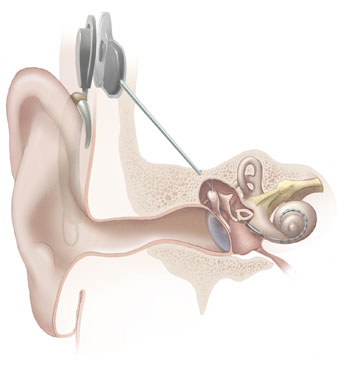
In a "hearing" ear, sound causes the ear drum to vibrate, which in turn vibrates the tiny bones in the middle ear. These vibrations move the fluid within the cochlear in the inner ear, and the flow moves against receptors (hairs) which fire electrical impulses up the auditory nerve to the brain. The sense of hearing is created by the brain's interpretation of these impulses.

Unlike a conventional hearing aid, a Cochlear Implant bypasses the eardrum, middle ear bones and cochlear hairs.  Instead, and from within the cochlear itself, the implant produces the electrical impulses required by the auditory nerve.

According to Wikipedia:

"A cochlear implant (CI) is a surgically implanted electronic device that provides a sense of sound to a person who is profoundly deaf or severely hard of hearing.
Cochlear Implants may help provide hearing in patients that are deaf due to damage to sensory hair cells in their cochlea. In those patients, they can often enable sufficient hearing to allow better understanding of speech. The quality of sound is different from natural hearing, with less sound information being received and processed by the brain. However, many patients are able to hear and understand speech and environmental sounds. Newer devices and processing strategies allow recipients to hear better in noise, enjoy music, and even use their implant processors while swimming."